> ## Documentation Index
> Fetch the complete documentation index at: https://docs.assetinfinity.ai/llms.txt
> Use this file to discover all available pages before exploring further.
# Inside a part
> Stock by store, the transaction ledger, suppliers, alternatives, what it fits and what it costs you.
 ## Tabs
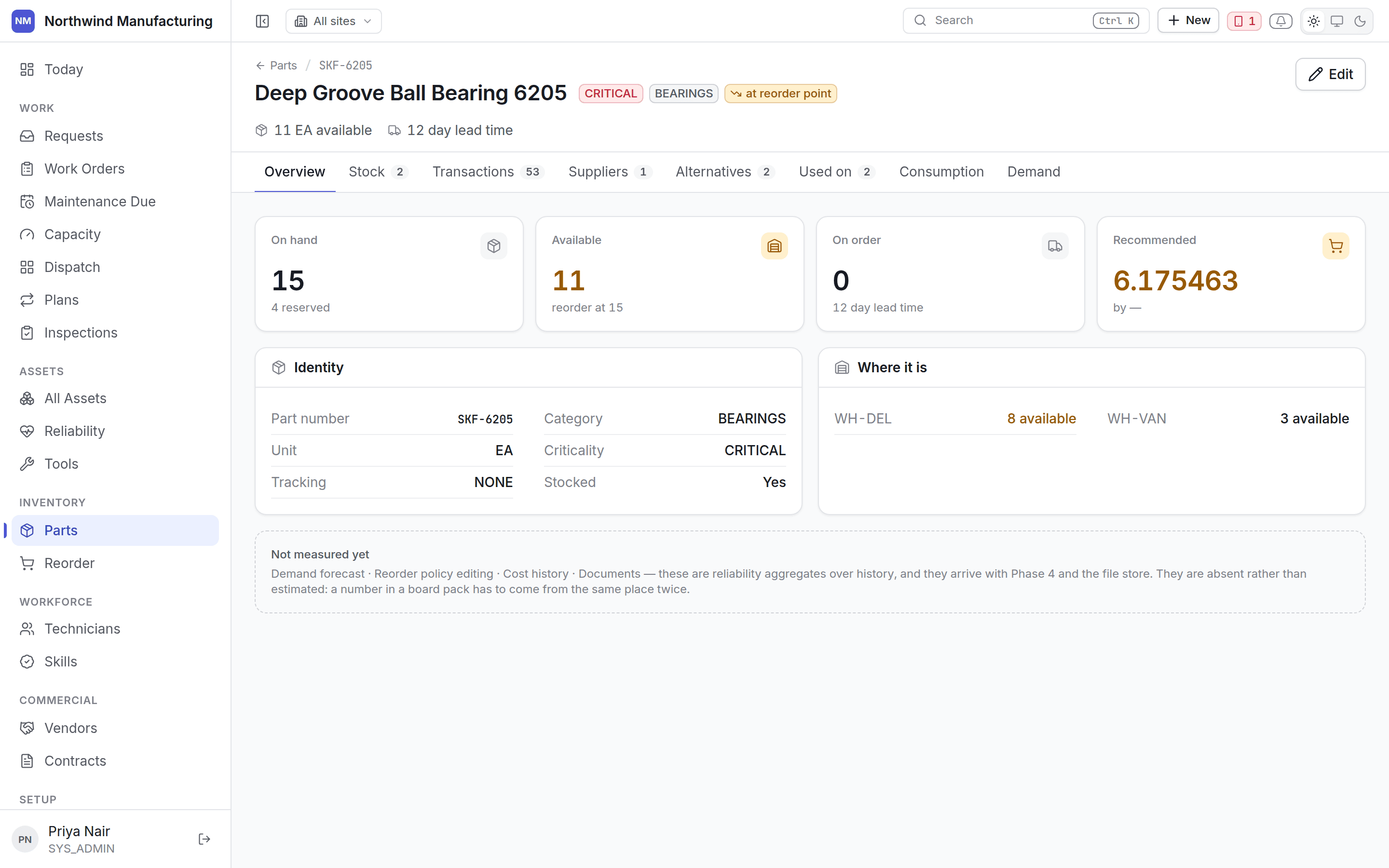
Part number, description, category, unit of measure, standard cost, and the totals across all
stores.
Where this part actually is — quantity per store, per bin, with each store's own reorder point.
## Tabs
Part number, description, category, unit of measure, standard cost, and the totals across all
stores.
Where this part actually is — quantity per store, per bin, with each store's own reorder point.
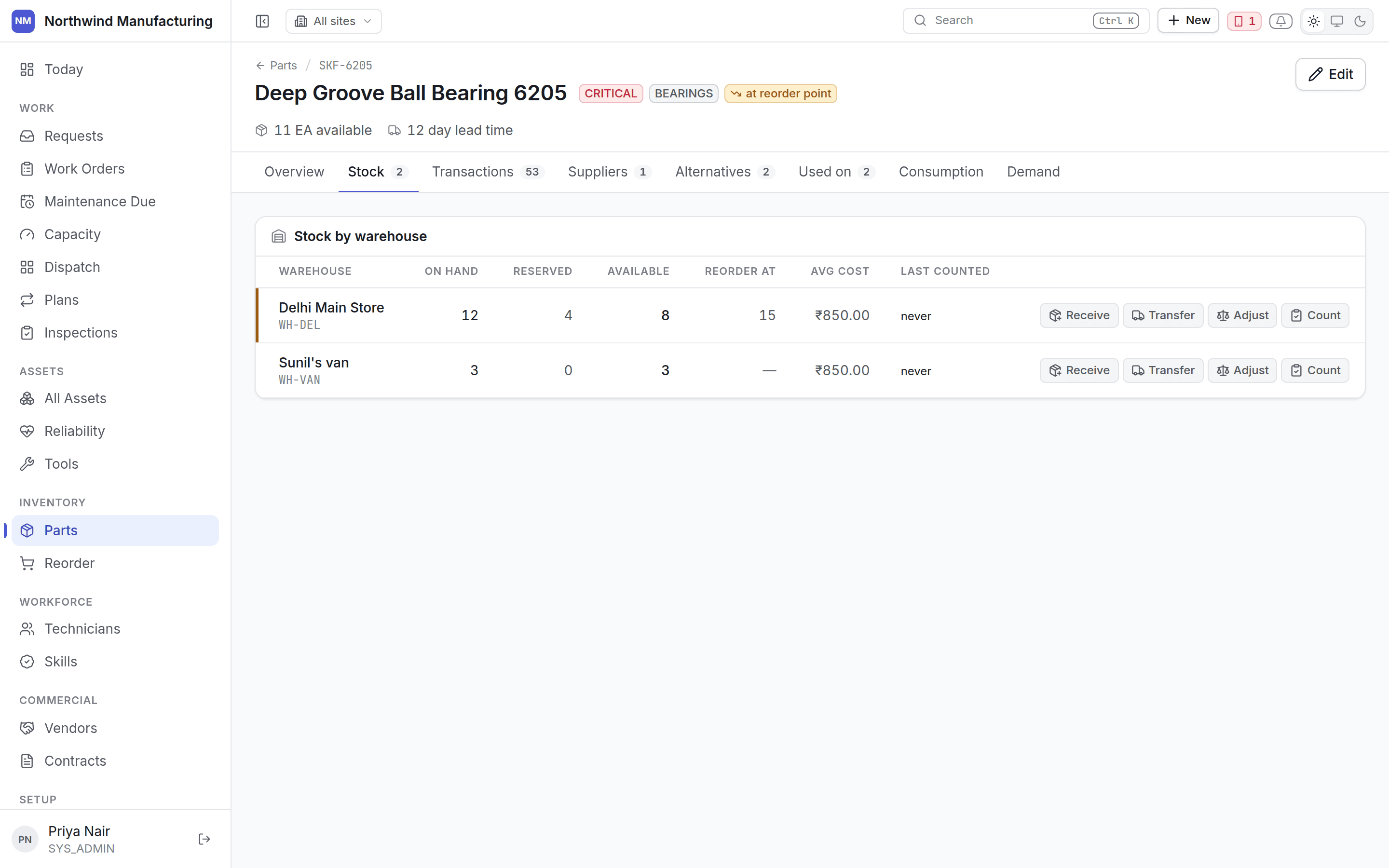 This is the tab that answers "we have twelve, but are any of them *here*".
The ledger: every receipt, issue, return, transfer and adjustment, with date, quantity, job and
who did it.
Every stock number in the product is derived from this ledger. If a figure looks wrong, this is
where the truth is.
Who sells it, at what price, with what lead time. Lead time is what makes a reorder
recommendation actionable — a part that takes six weeks needs reordering long before one that
arrives tomorrow.
Parts that will do instead. When stock is short, readiness and the reorder list can consider
substitutes rather than declaring a job blocked.
Which assets take this part — the reverse of an asset's bill of materials. Useful before
discontinuing something: this tab says what would be orphaned.
How much of it you actually get through, computed from the ledger rather than read from a
summary. A part with no summary is not a part with no history.
Consumption drives the demand rate the [reorder list](/inventory/reorder) works from.
## Issuing against a job
Parts are issued from a store against a work order. That does three things at once: it reduces
stock, it puts a cost on the job, and it adds to the consumption history that forecasts future
demand.
Whether parts may be issued at all depends on the status the job is in — a flag on your
[state model](/config/statuses), not a rule here.
## Adjustments
A stock count that disagrees with the ledger is corrected with an **adjustment**, which is itself a
transaction with a reason. Stock is never silently overwritten.
## Related topics
- [The part catalogue](/inventory/parts.md)
- [Inside an asset](/assets/detail.md)
- [Inside a work order](/work/work-order-detail.md)
- [Inside a technician](/workforce/technician-detail.md)
- [Inside a vendor](/commercial/vendor-detail.md)
This is the tab that answers "we have twelve, but are any of them *here*".
The ledger: every receipt, issue, return, transfer and adjustment, with date, quantity, job and
who did it.
Every stock number in the product is derived from this ledger. If a figure looks wrong, this is
where the truth is.
Who sells it, at what price, with what lead time. Lead time is what makes a reorder
recommendation actionable — a part that takes six weeks needs reordering long before one that
arrives tomorrow.
Parts that will do instead. When stock is short, readiness and the reorder list can consider
substitutes rather than declaring a job blocked.
Which assets take this part — the reverse of an asset's bill of materials. Useful before
discontinuing something: this tab says what would be orphaned.
How much of it you actually get through, computed from the ledger rather than read from a
summary. A part with no summary is not a part with no history.
Consumption drives the demand rate the [reorder list](/inventory/reorder) works from.
## Issuing against a job
Parts are issued from a store against a work order. That does three things at once: it reduces
stock, it puts a cost on the job, and it adds to the consumption history that forecasts future
demand.
Whether parts may be issued at all depends on the status the job is in — a flag on your
[state model](/config/statuses), not a rule here.
## Adjustments
A stock count that disagrees with the ledger is corrected with an **adjustment**, which is itself a
transaction with a reason. Stock is never silently overwritten.
## Related topics
- [The part catalogue](/inventory/parts.md)
- [Inside an asset](/assets/detail.md)
- [Inside a work order](/work/work-order-detail.md)
- [Inside a technician](/workforce/technician-detail.md)
- [Inside a vendor](/commercial/vendor-detail.md)