> ## Documentation Index
> Fetch the complete documentation index at: https://docs.assetinfinity.ai/llms.txt
> Use this file to discover all available pages before exploring further.
# Sites and organisation
> Sites, the location tree, working weeks, and the company structure costs roll up to.
Where everything is, and who it belongs to.
 ## Sites
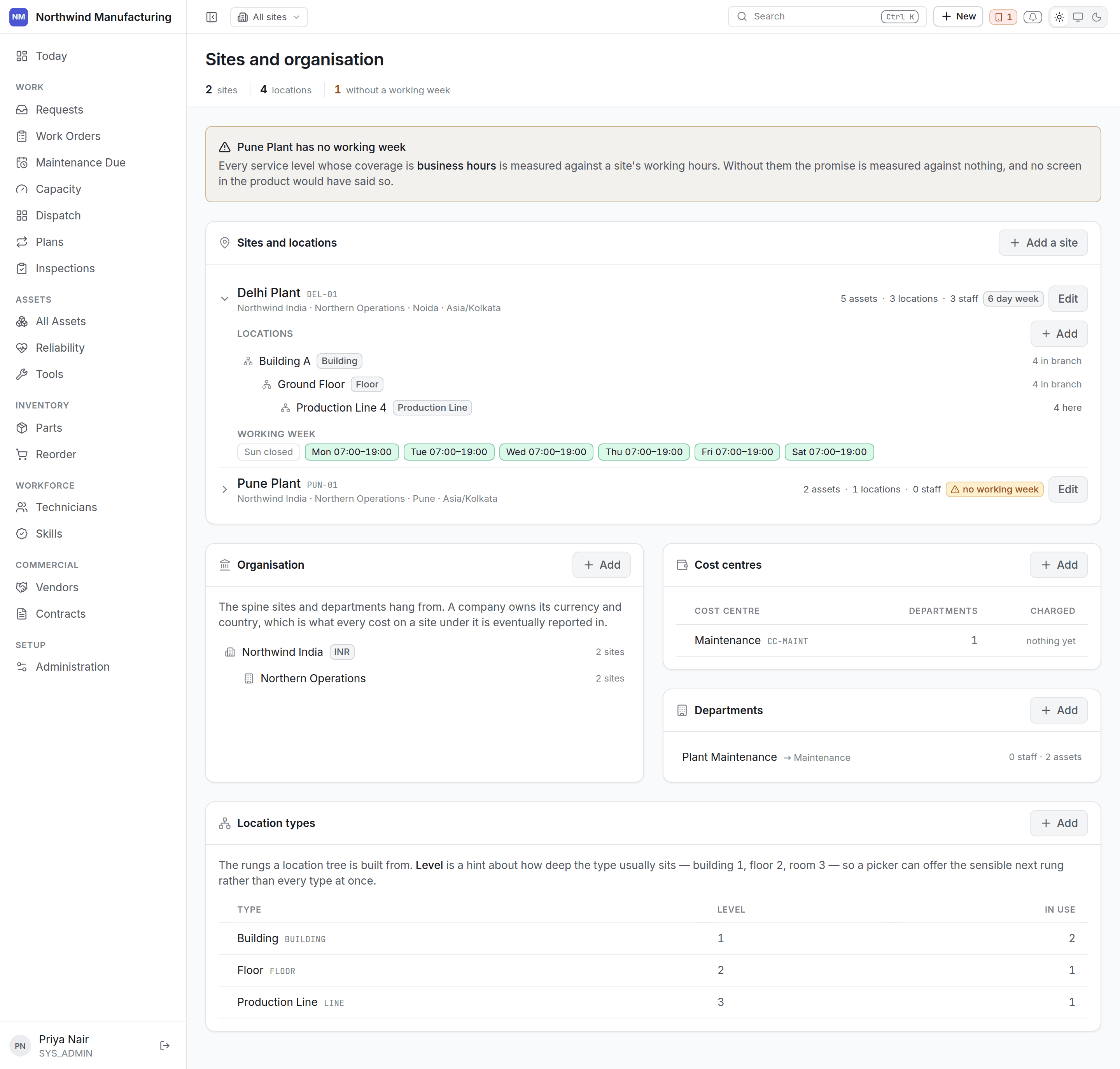
A site is a plant, a depot, a campus — somewhere with its own technicians and its own working week.
Sites matter more than they look:
* Technicians are **rostered at a site** and cannot absorb another site's load, which is why
[capacity](/work/capacity) never blends them.
* The **site switcher** narrows what you are looking at.
* **Site access** decides which sites a user may reach at all. See [access](/setup/access).
Each site carries its address, its timezone and its **working week** — which days and hours count as
working time. That is what service-level clocks and capacity are computed against, so a site that
runs Sunday to Thursday must say so.
## The location tree
Inside a site, locations nest as deeply as you need:
```text theme={null}
Delhi Plant
└── Building A
└── First floor
└── Production Line 4
└── Pump house
```
Assets live at locations. The tree is what makes "everything in Building A" a question you can ask —
of work, of cost, of downtime.
**Location types** — building, floor, line, room — are a configurable list, so your tree uses your
plant's vocabulary.
## Company structure
Separate from where things physically are, and used for cost rather than geography:
| Level | What it is |
| ----------------- | -------------------------------------------- |
| **Company** | A legal entity. Has its own default currency |
| **Business unit** | A division within a company |
| **Cost centre** | Where maintenance cost is booked |
| **Department** | Who owns the equipment operationally |
A single-plant operation can leave most of this alone. A group running several legal entities in
different currencies needs it, because that is what makes cost roll up correctly.
## Currency
Each company carries a default currency. Costs are recorded in the currency they occurred in and
carry their conversion, so a vendor invoiced in one currency and parts bought in another still total
correctly.
## Adding a site
**New** on the sites screen. A site needs a name, a code, an address, a timezone and a working week.
Build the location tree underneath it afterwards.
Think about site boundaries before loading data. Splitting one site into two later means moving
assets, re-rostering technicians and reassigning access — all possible, none pleasant.
## Related topics
- [Creating an organisation](/setup/sign-up.md)
- [Setting up the plant](/setup/overview.md)
- [Core concepts](/core-concepts.md)
- [Your first hour](/quickstart.md)
- [Copilot](/analytics/copilot.md)
## Sites
A site is a plant, a depot, a campus — somewhere with its own technicians and its own working week.
Sites matter more than they look:
* Technicians are **rostered at a site** and cannot absorb another site's load, which is why
[capacity](/work/capacity) never blends them.
* The **site switcher** narrows what you are looking at.
* **Site access** decides which sites a user may reach at all. See [access](/setup/access).
Each site carries its address, its timezone and its **working week** — which days and hours count as
working time. That is what service-level clocks and capacity are computed against, so a site that
runs Sunday to Thursday must say so.
## The location tree
Inside a site, locations nest as deeply as you need:
```text theme={null}
Delhi Plant
└── Building A
└── First floor
└── Production Line 4
└── Pump house
```
Assets live at locations. The tree is what makes "everything in Building A" a question you can ask —
of work, of cost, of downtime.
**Location types** — building, floor, line, room — are a configurable list, so your tree uses your
plant's vocabulary.
## Company structure
Separate from where things physically are, and used for cost rather than geography:
| Level | What it is |
| ----------------- | -------------------------------------------- |
| **Company** | A legal entity. Has its own default currency |
| **Business unit** | A division within a company |
| **Cost centre** | Where maintenance cost is booked |
| **Department** | Who owns the equipment operationally |
A single-plant operation can leave most of this alone. A group running several legal entities in
different currencies needs it, because that is what makes cost roll up correctly.
## Currency
Each company carries a default currency. Costs are recorded in the currency they occurred in and
carry their conversion, so a vendor invoiced in one currency and parts bought in another still total
correctly.
## Adding a site
**New** on the sites screen. A site needs a name, a code, an address, a timezone and a working week.
Build the location tree underneath it afterwards.
Think about site boundaries before loading data. Splitting one site into two later means moving
assets, re-rostering technicians and reassigning access — all possible, none pleasant.
## Related topics
- [Creating an organisation](/setup/sign-up.md)
- [Setting up the plant](/setup/overview.md)
- [Core concepts](/core-concepts.md)
- [Your first hour](/quickstart.md)
- [Copilot](/analytics/copilot.md)