

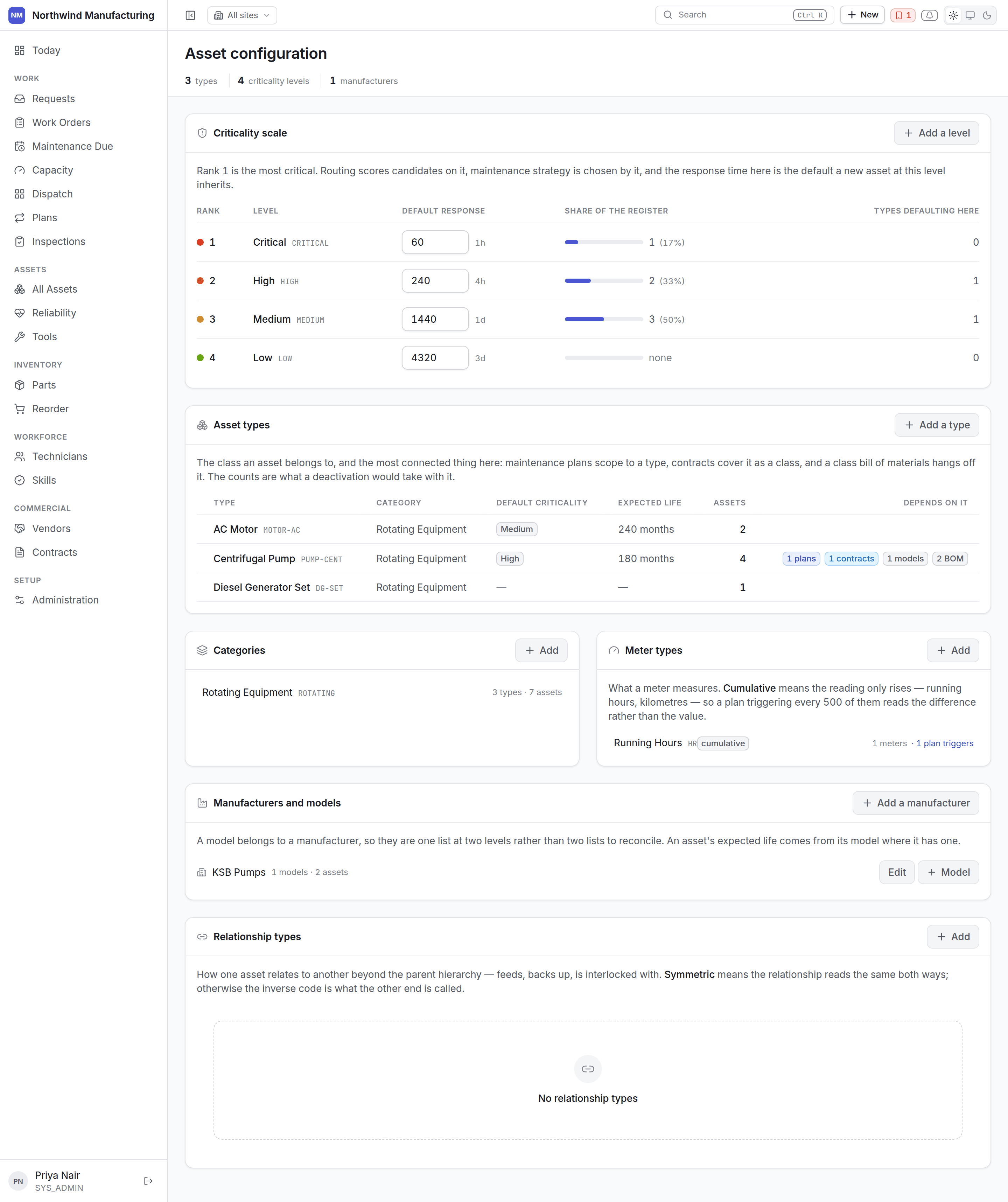
Configure these before loading assets. Reclassifying a thousand machines afterwards is
possible and tedious.
Criticality
How much it matters when a machine stops. The scale drives:- The priority of work raised against the asset.
- How routing ranks candidates for that work.
- How Reliability weighs a failure.
Asset types
What kind of thing it is: pump, motor, compressor, generator, conveyor. Types are how a maintenance plan describes its scope — every centrifugal pump at this site — so a well-chosen type list is what makes plans maintain themselves as the plant changes.Asset categories
A second axis, independent of type: rotating, static, electrical, instrumentation, mobile. Used for grouping and reporting.Meter types
What you count on a machine, and in what unit.
A cumulative meter never decreases — a reading below the last one is a mistake or a replaced
counter, and the product will say so. A point-in-time meter moves freely.
Meter types are what meter-based triggers name. See
meters and readings.